There are certain names that almost every Muslim recognizes. Imam al-Bukhari is one of them.
His collection, Sahih al-Bukhari, is studied in mosques, taught in Islamic schools, referenced in lectures, and read by Muslims around the world. For many of us, his name is so closely associated with the study of hadith that we rarely stop to consider the person behind it.
But there is a detail in his name worth paying attention to.
Al-Bukhari.
It refers to where he came from: Bukhara, a historic city in Central Asia, in present-day Uzbekistan.
Not Makkah. Not Madinah. Not Cairo or Damascus. Bukhara.
A city thousands of miles from the Arabian Peninsula produced one of the most influential scholars in Islamic history. And his story is a reminder of just how geographically expansive the early Muslim world had become.
A Scholar from Central Asia
Muhammad ibn Ismail al-Bukhari was born in Bukhara in 810 CE, during a period when Central Asia was an important center of trade, learning, and scholarship.
Located along the ancient Silk Road, Bukhara was connected to cities and civilizations across Asia and the Middle East. Merchants, travelers, and scholars moved through the region, carrying goods, ideas, and knowledge across vast distances.
Islamic scholarship was flourishing well beyond the Arabian Peninsula, and Central Asia was an important part of that intellectual landscape.
Al-Bukhari began studying hadith as a child. His father was also a hadith scholar, and accounts of his early life describe an extraordinary memory and aptitude for retaining narrations.
But his education would take him far beyond his hometown.
At around sixteen, he traveled with his family to Makkah for Hajj. After the pilgrimage, he remained in the region to pursue his studies, eventually traveling to other major centers of Islamic learning, including Madinah, Baghdad, Basra, Kufa, Damascus, and Cairo.
In the 9th century, this was no small undertaking. There were no planes, trains, or digital libraries. Knowledge was carried by people, preserved in manuscripts and memory, and transmitted through relationships between teachers and students.
Al-Bukhari spent years seeking out scholars, studying their narrations, and comparing different chains of transmission. He is traditionally reported to have studied with more than a thousand scholars throughout his travels.
His journey illustrates something important about the early Muslim world: scholarship was not confined to one region. A scholar born in Central Asia could build a body of knowledge through connections spanning the Hijaz, Iraq, Syria, Egypt, and beyond.
How Did He Compile Sahih al-Bukhari?
To understand al-Bukhari's legacy, it helps to understand what hadith scholarship involved.
A hadith is not simply a statement attributed to the Prophet Muhammad ﷺ. Each narration comes with a chain of transmission, known as an isnad, identifying the people through whom the report was passed down.
Scholars examined these chains carefully. They considered the reliability and memory of individual narrators, whether they had lived at the same time, whether they could have met, and whether the narration was consistent with other known reports.
This was a rigorous discipline, developed over generations of Muslim scholarship.
Al-Bukhari became one of its most accomplished practitioners.
He did not simply record every narration he encountered. He evaluated reports against demanding standards, selecting those he considered authentic for his collection. Traditional accounts describe him examining an enormous body of narrations before including a much smaller selection in Sahih al-Bukhari. The often-cited figure is approximately 600,000 narrations considered, with around 7,563 included when repetitions are counted.
The collection took years to compile and was organized into chapters covering subjects ranging from belief and worship to ethics, family life, and everyday conduct.
Its influence would extend far beyond al-Bukhari's lifetime. Today, Sahih al-Bukhari holds a central place in Sunni Islam and is traditionally regarded as the most authoritative hadith collection after the Qur'an.
From Makkah to Bukhara
There is a particularly interesting detail in the story of the collection itself.
Traditional accounts describe al-Bukhari beginning the compilation of Sahih al-Bukhari in the Hijaz, with his work associated with the sacred mosques in Makkah and Madinah. After years of study, travel, and scholarship, he completed it in Bukhara, the city where his own story had begun.
Think about that for a moment.
A work that would become foundational to Islamic scholarship was shaped by knowledge gathered across the Muslim world, then completed in a city in Central Asia.
Bukhara was not simply the place where al-Bukhari happened to be born. It was part of the intellectual world that produced him and the setting in which he brought his life's work to completion.
Al-Bukhari died in 870 CE in Khartang, a village near Samarkand in present-day Uzbekistan. His burial place eventually became an important site of visitation. Today, the Imam al-Bukhari Memorial Complex stands near Samarkand, while Bukhara remains closely associated with his name and legacy.
Seeing Bukhara Through a Different Lens
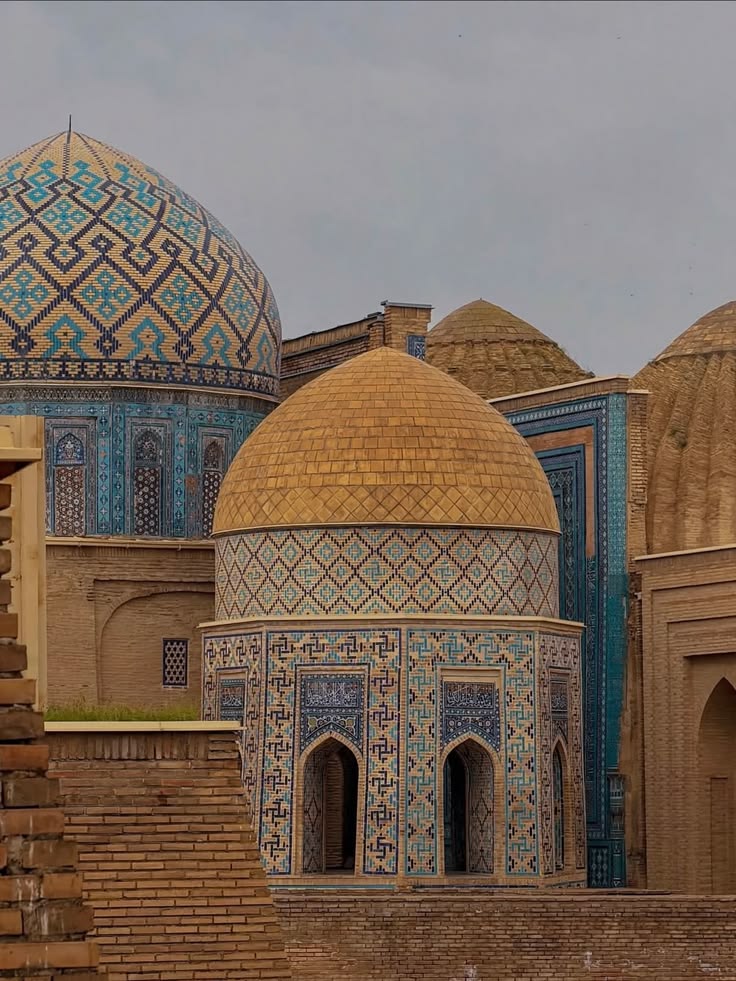
Today, Bukhara is known for its historic old city, its madrasas, mosques, trading domes, and distinctive Central Asian architecture. Its streets and monuments offer a glimpse into centuries of history along the Silk Road.
But knowing that Imam al-Bukhari was born here adds another dimension to the city.
You are not simply exploring a beautifully preserved historic destination. You are visiting a place that played a significant role in the intellectual history of Islam.
For many Muslims, the name al-Bukhari is familiar from childhood. We encounter his work in our religious education, hear his narrations in lectures, and refer to his collection throughout our lives. Yet we may never have connected that name to a city in Uzbekistan.
His story is a reminder that the history of Islam is not confined to the Arabian Peninsula or the Middle East. Its intellectual traditions were built across an enormous geography, by scholars who traveled extraordinary distances in pursuit of knowledge.
And some of the most influential figures in our religious tradition came from places we may never have thought to look.
The next time you hear the name Imam al-Bukhari, picture Bukhara.
A historic city in Central Asia, and an essential part of our shared Muslim heritage.
At Heritage by Ibadah, these are the connections we love to uncover: the people, places, and histories that make the Muslim world so much bigger than we sometimes imagine.